We called it. For months, we’ve been telling Charlotte business owners that ads would eventually appear inside AI search results. The economics just made too much sense. Now it’s actually happening. Adthena, a search intelligence platform, just became the first company to detect ads running inside Google’s AI Overviews. Only 13 ads appeared across 25,000 search results pages. That’s a tiny 0.052% frequency. But make no mistake. This changes everything about the future of paid search.

We Predicted This Would Happen (Here’s Why)
At Digital Marketing Charlotte, we’ve been watching the AI search space closely. We knew ads inside AI results were inevitable. The question was never if but when and how. The business model for AI search platforms simply doesn’t work without advertising revenue. Every major AI chatbot and search platform currently operates at a significant loss. The computational costs are staggering. Processing queries through large language models requires massive server infrastructure. The electricity bills alone could power small cities.
Computational Cost: The amount of processing power and energy required to run AI models and generate search results, typically measured in dollars per query.
Right now, companies like OpenAI, Google, and Microsoft are subsidizing these AI tools. User subscriptions don’t come close to covering expenses. ChatGPT Plus costs $20 per month. That doesn’t scratch the surface of what it costs OpenAI to process millions of daily queries. Google’s AI Overviews are free. They’re losing money on every single query that triggers an AI-generated response.
This isn’t sustainable. Historically, platforms that offer free search and information services survive through advertising. Google became a trillion-dollar company by selling ads next to search results. Facebook built an empire on ad dollars. YouTube makes billions from pre-roll ads. Without eventually monetizing through business advertising, AI platforms would need to charge consumers hundreds of dollars monthly. That won’t fly in the real world.
Many AI companies have publicly denied plans to inject ads into their platforms. We never bought it. The math simply doesn’t work any other way. Now we’re seeing the first proof that our prediction was correct.
What Adthena Actually Found
Adthena monitored 25,000 search results pages containing AI Overviews during their study period. Out of all those pages, they detected just 13 instances where ads appeared. That’s an incredibly low frequency. But it proves the concept is real and Google is actively testing monetization.
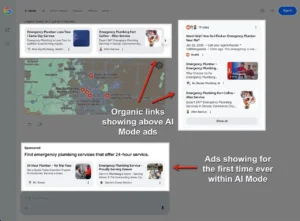
All detected ad placements appeared on desktop searches in the United States. Mobile wasn’t part of this initial test. The ads appeared directly beneath the AI-generated summary, not above it. This placement strategy makes sense. Google wants users to read the AI answer first, then present commercial options.
The ad format itself looks familiar but with a twist. Each ad included the standard elements you’d expect. Blue clickable headline. Description text. Brand name and URL. A clear “Sponsored” label so users know it’s paid placement. But here’s what’s different. These ads also featured thumbnail images, similar to what you see in Google Shopping results. This hybrid format combines text ad simplicity with visual product appeal.
AI Overview: Google’s generative AI feature that appears at the top of search results, synthesizing information from multiple sources to answer queries directly on the results page.
Headlines averaged around 55 characters. Descriptions came in at roughly 85 characters. These are shorter than traditional expanded text ads, which suggests Google is optimizing for the limited space inside AI Overview modules. The detected ads spanned multiple industries. Education. Consumer electronics. Retail. Telecommunications. Healthcare. This indicates Google is testing across various verticals to see what works.
Pro Insight: The thumbnail image addition is strategic. Shopping ads have always outperformed text-only formats because humans process visual information faster than text. Google knows this.
The Performance Max Question
Business owners always ask us which campaign type performs best. For these AI Overview placements, we strongly suspect Google is using Performance Max campaigns. Here’s why that makes sense. Performance Max is Google’s fully automated campaign type that runs across all Google properties. Search, Display, YouTube, Gmail, Discovery. The system uses machine learning to optimize placements automatically.
Performance Max: Google’s AI-driven campaign type that automatically distributes ads across all Google channels, using machine learning to optimize performance based on conversion goals.
Google has been aggressively pushing advertisers toward Performance Max over the past two years. They’re sunsetting older campaign types and funneling everyone into this automated system. If AI Overviews become a new ad placement, Performance Max would be the natural delivery mechanism. Advertisers wouldn’t manually bid on AI Overview placements. The algorithm would just add it to the rotation.
This also means you likely can’t control whether your ads appear in AI Overviews right now. Performance Max doesn’t give advertisers granular placement control. You set conversion goals and budgets. The system handles everything else. If Google decides your ad is relevant for an AI Overview placement, it’ll show there. You won’t get a checkbox to opt in or out.
Can You Run Ads There Right Now?
The short answer is no, not reliably. This is clearly an early-stage test. With only 13 detected placements out of 25,000 opportunities, Google is being extremely selective about when and where these ads appear. You can’t log into Google Ads today and specifically target AI Overview placements. That feature doesn’t exist yet.
What likely happened is Google identified certain queries where AI Overviews appeared and decided to test ad placements. The advertisers whose ads showed up probably didn’t know they were running in AI Overviews. Their Performance Max campaigns just happened to match the right criteria at the right time.
For Charlotte business owners wondering if this affects your current strategy, the answer is not yet. You can’t optimize for AI Overview placements because they’re not widely available. Your existing Google Ads campaigns will continue running in traditional placements. Search results, Shopping tabs, Display network. Nothing changes on your end today.
But this is absolutely the time to start thinking about AI visibility. The trajectory is clear. Google will expand this test. More ads will appear in more AI Overviews. Eventually, this becomes a standard placement option. The advertisers who understand this shift early will have a competitive advantage.
What This Means for Your Paid Search Strategy
Right now, this news doesn’t require immediate action. Your Google Ads campaigns should continue running as planned. The frequency is too low to impact performance metrics. But smart business owners should start preparing for a future where AI placements become significant.
First, make sure your Performance Max campaigns are properly structured. If Google expands AI Overview ads through Performance Max, you want to be in the mix. That means having solid conversion tracking, quality product feeds if you’re in e-commerce, and diverse ad assets. Headlines, descriptions, images, videos. Give the algorithm options to work with.
Second, focus on the fundamentals that make any ad successful. Clear value propositions. Strong calls to action. Landing pages that convert visitors into customers. Whether your ad appears in traditional search results or inside an AI Overview, these basics still matter most.
Third, monitor your search impression share metrics closely. Adthena’s research found that AI Overviews can reduce traditional paid search click-through rates by 8 to 12 percentage points. That’s roughly a 20 to 40 percent relative decline. As AI answers take up more screen real estate, fewer users scroll down to regular ad placements. Your performance might dip even if your campaigns haven’t changed.
Impression Share: The percentage of times your ad appears compared to the total number of times it was eligible to appear, indicating how much of the available market you’re capturing.
Understanding why performance drops helps you respond correctly. If your click-through rates decline because AI Overviews are answering queries directly, that’s not a campaign quality issue. That’s a SERP layout change. You might need to shift budget toward longer-tail keywords that don’t trigger AI Overviews as frequently.
The Bigger Picture for AI Search Advertising
This Adthena finding represents more than just Google testing a new ad format. It signals the beginning of a fundamental transformation in how search advertising works. For over two decades, the search ad model has been relatively stable. User types query. Search engine shows results. Ads appear above and beside organic listings. Everyone understands the rules.
AI search changes those rules completely. Now the search engine answers the query directly. Users get information without clicking through to websites. The traditional traffic flow gets disrupted. For publishers and content creators, this is scary. Their website traffic decreases. For advertisers, it creates both challenges and opportunities.
The challenge is obvious. If AI answers satisfy user intent immediately, there’s less reason to click ads. Fewer clicks mean lower conversion volume. But the opportunity is equally significant. Ads inside AI results could have higher intent than traditional placements. A user who reads an AI-generated answer and still sees a relevant sponsored option might be further along the buying journey.
Google is walking a tightrope. They need to monetize AI Overviews to justify the massive investment. But they can’t overwhelm users with ads to the point where the AI experience feels polluted. That delicate balance will determine how aggressively Google rolls this out.
Other AI platforms are watching closely. OpenAI, Microsoft Bing, Perplexity. They all face the same monetization pressure. If Google proves that ads inside AI results work without degrading user experience, every AI search platform will follow. We might see sponsored answers in ChatGPT within months. Bing could start highlighting paid results in their AI chat. The entire search landscape could shift faster than most businesses realize.
What Charlotte Business Owners Should Do Now
Don’t panic. This isn’t an emergency that requires immediate campaign overhauls. But don’t ignore it either. The smart move is informed preparation. Start by auditing your current Google Ads setup. Are you running Performance Max campaigns? If not, consider testing them alongside your existing search campaigns. They’re likely going to be the gateway to AI Overview placements.
Next, improve your ad creative quality. The ads detected in this study featured compelling headlines and relevant thumbnail images. Generic, low-effort ads probably won’t make the cut as Google expands the program. Invest in better product photography. Write headlines that grab attention. Test different messaging angles.
Also, think about your overall digital marketing mix. If AI Overviews reduce traffic from both organic and paid search, where else can you reach customers? Social media advertising. Email marketing. Content marketing on your own platforms. Smart businesses don’t put all their eggs in one basket. Diversification protects you when any single channel changes dramatically.
Finally, stay informed. This is a rapidly evolving situation. What’s true today might be outdated in three months. Subscribe to industry newsletters. Follow search marketing news. Work with a digital marketing agency in Charlotte that monitors these trends and adjusts strategies accordingly.
The Future is Already Here
We predicted ads would appear in AI search results. We just didn’t know exactly when or how. Now we have our answer. It’s happening right now in limited tests. Google is being cautious, but the direction is unmistakable. AI search is getting monetized through advertising. Every business that relies on digital marketing needs to understand what this means.
The businesses that thrive in this new environment will be the ones who adapt quickly. They’ll optimize for AI visibility while maintaining strong traditional search presence. They’ll create ad content that works in both contexts. They’ll track performance across multiple metrics instead of obsessing over a single channel.
This isn’t the end of search advertising. It’s evolution. The fundamental principle remains the same. Businesses pay to get in front of potential customers at the exact moment they’re looking for solutions. The format changes. The platforms evolve. But human buying behavior stays remarkably consistent. People search for products and services. They evaluate options. They make decisions. Smart advertising helps guide that process regardless of where the ads appear.
Charlotte business owners who embrace this shift instead of fighting it will find opportunities their competitors miss. The early movers always have an advantage. By the time everyone else catches on, you’ll already have data and experience that newcomers lack.
Ready to Future-Proof Your Digital Marketing?
The search landscape is changing faster than ever. AI Overviews, new ad formats, shifting user behavior. Trying to keep up while running your business is nearly impossible. That’s where we come in.
At Digital Marketing Charlotte, we stay ahead of industry changes so you don’t have to. We monitor developments like Google’s AI Overview ads before they become mainstream news. We adjust client strategies proactively instead of reactively. Whether it’s SEO services, PPC advertising, or comprehensive digital strategy, we help Charlotte businesses win in competitive markets.
Want to discuss how these AI search changes might affect your business? Let’s talk. Schedule a free consultation and we’ll walk through your current marketing, identify vulnerabilities, and create a plan that keeps you visible no matter how search engines evolve.